



What are the highest-paying jobs in Singapore for young professionals aged 25 to 29?
Do technical careers dominate the rankings, or do other fields compete? What skills and qualifications could help you reach these roles?
This guide compares eight occupations using MOM wage data. You will learn about their salaries, responsibilities, requirements and possible career pathways.
Quick Takeaways
- The highest-paying jobs listed offer median gross monthly wages ranging from S$6,946 to S$9,500.
- AI and machine learning engineers lead the ranking with a S$9,500 median monthly wage.
- The top roles span AI, marketing, data, technology, medicine, cybersecurity and workplace training.
- Each career requires different skills, experience, qualifications or professional registration to enter and progress.
- To pursue a higher-paying career, identify your skills gap and build evidence through practical projects.
Table of contents
How We Ranked the Highest-Paying Jobs in Singapore
This ranking uses MOM’s Occupational Wages 2025 data, released on 30 June 2026.
The figures show median gross monthly wages in June 2025. They cover full-time resident employees aged 25 to 29 from establishments with at least 200 employees.
We ranked the published occupations from highest to lowest gross wage for young professionals aged 25 to 29. These figures exclude bonuses and do not represent guaranteed starting salaries.
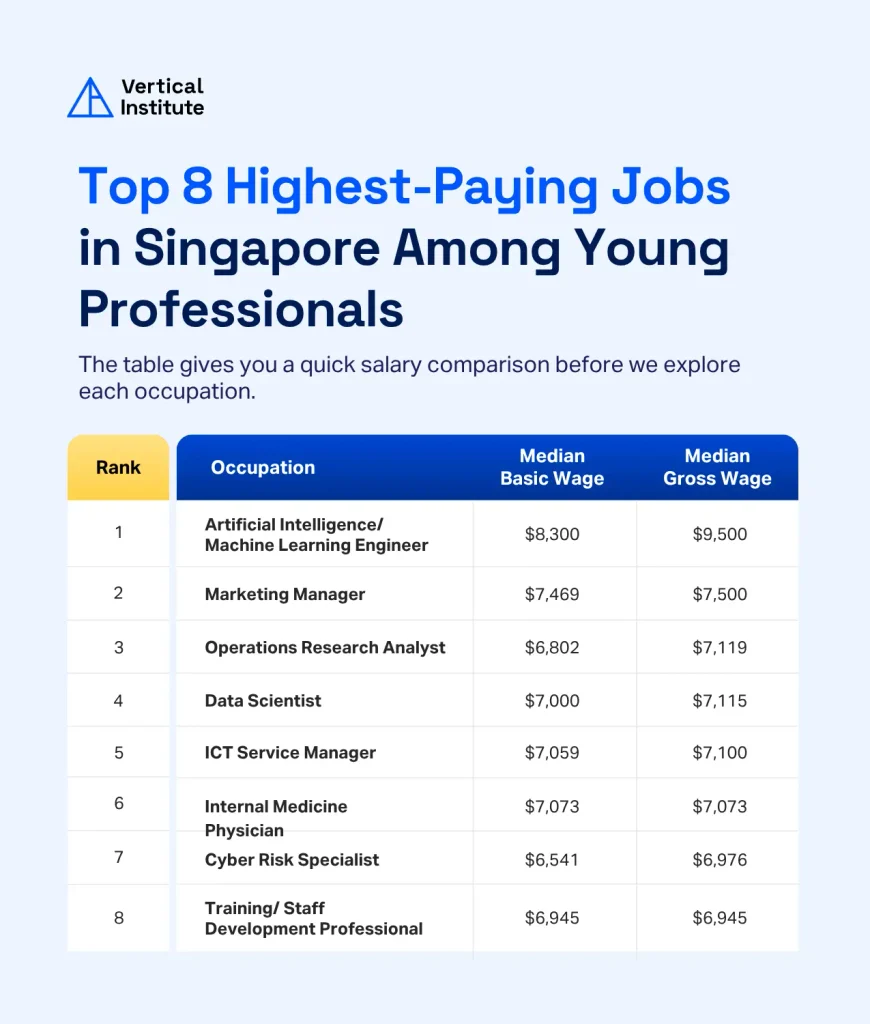
Top 8 Highest-Paying Jobs in Singapore Among Young Professionals
The table gives you a quick salary comparison before we explore each occupation.
1. Artificial Intelligence/Machine Learning Engineer
Median gross monthly wage: S$9,500
AI and machine learning engineers develop systems that learn from data. These systems predict outcomes, recommend actions or automate decisions.
Their responsibilities may include:
- Preparing data for model training
- Building and testing machine learning models
- Measuring and improving model performance
- Deploying models into applications and workflows
- Monitoring models after deployment
This role requires programming, statistics and problem-solving skills. Engineers may also work with APIs, AI agents and cloud platforms.
Employers often seek qualifications in computer science, engineering, mathematics or related fields. Applied projects can help demonstrate your technical knowledge.
Possible entry routes include software engineering, data analysis and junior machine learning roles. These positions can build your programming, data preparation and model development experience.
 AI-Integrated
Generative AI Course
Boost efficiency and enhance productivity using Generative AI.
2. Marketing Manager
Median gross monthly wage: S$7,500
Marketing managers plan how businesses attract, engage and retain customers. They oversee campaigns across digital and offline channels.
Their responsibilities may include:
- Developing marketing strategies
- Managing campaign budgets
- Reviewing customer research
- Overseeing content and advertising
- Tracking campaign performance
- Coordinating teams and agencies
Marketing managers need commercial judgement, communication and leadership skills. They must also understand digital channels and campaign data.
Most professionals reach this position after gaining hands-on marketing experience. Common entry routes include marketing executive, digital marketer and channel specialist roles.
Managing campaigns can help you develop budgeting and stakeholder management skills. You also need to show how your work supports leads, sales or customer growth.
AI-Integrated 
Digital Marketing Course
Gain digital marketing skills in SEO, SEM, social media & more.
3. Operations Research Analyst
Median gross monthly wage: S$7,119
Operations research analysts use data and mathematical models to solve operational problems. They compare possible outcomes before recommending an approach.
Their work may involve:
- Improving delivery routes
- Planning employee or resource schedules
- Managing inventory levels
- Comparing operating costs
- Supporting budget allocation
- Testing possible business scenarios
These analysts may work across transport, healthcare, finance and supply chain functions.
The role requires mathematics, statistics, data analysis and structured problem-solving skills. Analysts must also explain technical findings to business teams.
Employers may seek qualifications in mathematics, statistics, economics, engineering or operations research.
Possible entry routes include data analyst, business analyst and operations analyst positions. These roles can help you practise turning data into practical recommendations.
Related Article: Entry-Level Data Analyst Salary in Singapore 2026 Updates
AI-Integrated 
Data Analytics Course
Turn data to practical insights Using SQL, Excel & Tableau
4. Data Scientist
Median gross monthly wage: S$7,115
Data scientists analyse complex datasets to identify patterns and predict outcomes. Their findings can support planning, risk management and customer decisions.
Their responsibilities may include:
- Collecting and cleaning data
- Exploring patterns within datasets
- Building predictive models
- Testing model performance
- Creating data visualisations
- Presenting findings to stakeholders
For example, a retailer might use data science to forecast product demand. A bank could apply it to detect unusual transactions.
This role requires programming, statistics and machine learning skills. You also need to explain findings clearly to non-technical teams.
Employers may seek technical qualifications or applied project experience. Many professionals start in data analyst or business analyst roles before developing deeper modelling skills.
AI-Integrated 
Data Science & AI Course
Stay Relevant: Learn Python, AI, Machine Learning & More.
5. ICT Service Manager
Median gross monthly wage: S$7,100
ICT service managers oversee technology services, systems and support teams. They help ensure these services meet business and user needs.
Their responsibilities may include:
- Monitoring service quality and performance
- Managing technology budgets and resources
- Coordinating technical teams
- Responding to service disruptions
- Reviewing operational and security risks
- Managing stakeholder expectations
This role requires technical knowledge, communication and team management skills. Managers must explain complex issues to employees without technical backgrounds.
Most professionals enter this role after gaining experience in ICT support, systems administration or service delivery.
Supervisory experience can also prepare you to manage employees, vendors and competing priorities. This position rarely represents an entry-level career.
6. Internal Medicine Physician
Median gross monthly wage: S$7,073
Internal medicine physicians diagnose and manage illnesses affecting adult patients. They may treat complex conditions involving several organs or health concerns.
Their responsibilities may include:
- Reviewing symptoms and medical histories
- Ordering and interpreting tests
- Diagnosing illnesses
- Developing treatment plans
- Monitoring patient progress
- Coordinating care with other specialists
This career requires recognised medical education and supervised clinical training. Physicians must also secure professional registration before practising in Singapore.
Those pursuing specialist roles may need further postgraduate training in internal medicine.
Unlike several other careers on this list, short courses cannot provide the required medical pathway. Prospective physicians should review current education and registration requirements.
7. Cyber Risk Specialist
Median gross monthly wage: S$6,976
Cyber risk specialists identify digital threats that could affect systems, data and business operations. They help organisations understand and manage potential damage.
Their responsibilities may include:
- Reviewing security controls and policies
- Assessing cyber risks
- Supporting audits and compliance reviews
- Evaluating incident response plans
- Reporting risks to management
- Recommending suitable controls
The role combines cybersecurity knowledge with risk assessment and communication skills. Specialists often work with technical, legal, compliance and management teams.
Possible entry routes include cybersecurity operations, technology audit and compliance roles. These positions can build your knowledge of security controls and business risks.
Industry certifications or relevant qualifications may also support your progression. Requirements will depend on the employer and role scope.
AI-Integrated 
Cybersecurity Course
Acquire key Cybersecurity skills and tools for a career boost.
Related Article: Cyber Security Salary in Singapore 2026: Pay, Roles, and Career Outlook
8. Training/Staff Development Professional
Median gross monthly wage: S$6,945
Training and staff development professionals help employees build skills for their roles. They connect learning plans with workplace needs and business goals.
Their responsibilities may include:
- Identifying employee skills gaps
- Planning workplace training programmes
- Developing learning materials
- Coordinating trainers and participants
- Measuring training outcomes
- Working with managers and external providers
This role requires communication, programme planning and stakeholder management skills. You also need to understand how employees learn and apply new knowledge.
Possible entry routes include training coordinator, learning support executive and human resources roles.
Experience managing workshops or employee programmes can support your progression. You should also show how your training work improves workplace performance.
Related Article: How Much Does a Fresh Graduate Earn in Singapore? (Digital Career Guide 2026)
Courses That Can Support These Career Paths
Some Vertical Institute courses cover skills used within these careers. Choose a course based on your skills gap, not the salary alone.
| Occupation | Supporting Skill Area | Relevant Vertical Institute Course |
| Artificial Intelligence/Machine Learning Engineer | AI systems, automation, data science and machine learning | Generative AI Course, Generative AI Workflow Automation Course, Data Science & AI Course, Advanced Data Science Course |
| Marketing Manager | Campaign planning, search marketing and performance measurement | Digital Marketing Course, SEO Marketing Course, Mastering Google Analytics 4 |
| Operations Research Analyst | Data analysis and analytical decision-making | Data Analytics Course, Advanced Data Analytics Course |
| Data Scientist | Data science, machine learning and predictive modelling | Data Science & AI Course, Advanced Data Science Course |
| ICT Service Manager | Team leadership, communication and workplace relationships | Leading with Clarity: From Strategy to Team Results Course, Effective People and Relationship Management Course |
| Internal Medicine Physician | Medical education and clinical training | No direct course connection |
| Cyber Risk Specialist | Cyber risk management, security controls, regulations and incident response | Cybersecurity Course |
| Training/Staff Development Professional | Leadership, communication and employee relationships | Leading with Clarity: From Strategy to Team Results Course, Effective People and Relationship Management Course |
These courses can help you address selected skills gaps. They do not replace degrees, licences or work experience required for certain occupations.
How to Work Towards a High-Paying Career
High-paying roles often require specialised knowledge, relevant experience or professional qualifications.
Before choosing your next step, compare the career requirements with your current background.
Understand the Career Requirements
Each occupation follows a different career pathway.
| Career Pathway | Occupations | Common Requirements |
| Regulated profession | Internal Medicine Physician | Medical degree, clinical training and professional registration |
| Technical specialist | AI/ML Engineer, Operations Research Analyst, Data Scientist, Cyber Risk Specialist | Technical skills, applied projects and relevant experience |
| Management | Marketing Manager, ICT Service Manager | Industry experience, leadership skills and commercial knowledge |
| Workplace learning | Training/Staff Development Professional | Training knowledge, communication and stakeholder management |
Check the required pathway before paying for training or applying for roles.
Some skills can come from courses and projects. Regulated careers may require specific qualifications, supervised training and professional registration.
Identify Your Current Skills Gap
Review several job listings for your target role. Look for skills and qualifications that appear repeatedly.
Then follow these steps:
- Compare the common requirements with your current experience.
- Identify the main gap blocking your next move.
- Choose training or projects that address that gap.
- Build evidence showing how you applied the skill.
- Consider a stepping-stone role if direct entry remains unrealistic.
For example, an aspiring data scientist might first pursue data analyst roles. This route builds experience in data cleaning, reporting and visualisation.
A future marketing manager could begin by managing campaigns. They can then progress towards strategy, budgets and team leadership.
Focus on one clear gap first. Trying to master every listed skill may slow your progress.
Evaluate the Full Career Path
A higher salary may require years of training, formal qualifications or demanding responsibilities.
Consider how long entry could take and what it may cost. Review the daily work, progression opportunities and demand for the role.
Then ask yourself:
- Does the work suit your strengths?
- Can you meet the entry requirements?
- Does the career offer a realistic next step?
- Would you still pursue it if its salary ranked lower?
The best career target should fit your skills, circumstances and long-term goals.
How AI Skills Helped One VI Alumnus Secure a 33% Pay Rise
Lim Yi Ping built practical AI skills, then demonstrated their value during job interviews.
He showed employers how his Custom GPT could create targeted Google and Facebook advertisements. This proved he could apply AI to real marketing work.
“After taking the Gen AI course with Vertical Institute, I did live AI automation demos during job interviews. As a result, 3 of 4 companies extended their job offers to me,” he told CNA Money Mind.
Yi Ping received three job offers and secured a 33% pay rise.
His experience reflects a key lesson from this ranking. Reaching a higher-paying role requires more than learning new skills. You also need to show employers how those skills improve productivity, solve problems or support business results.
FAQs About the Highest-Paying Jobs in Singapore
What is the highest-paying job for young professionals in Singapore?
AI and machine learning engineer ranks first in this list. The median gross monthly wage reached S$9,500 for residents aged 25 to 29.
What is the best career to pursue in Singapore?
No single career suits everyone. The highest-paying job may not offer the best fit for your skills, interests or circumstances. Compare the entry requirements, daily work and progression opportunities before choosing.
What does ‘median gross monthly wage’ mean?
It represents the middle wage within an occupation. Half of the employees earned less, while the other half earned more.
Can professionals over 29 use this career information?
Yes. The responsibilities and career pathways remain relevant. Only the salary ranking focuses on residents aged 25 to 29.
Which high-paying careers may suit career switchers?
Data, digital marketing, cybersecurity and workplace training offer possible stepping-stone roles. Your existing skills and experience will shape your entry point.
Can a short course qualify you for these jobs?
A short course can help you build specific skills, but it cannot replace every job requirement. Specialised careers may require degrees, licences or work experience. Internal medicine physicians need medical education, clinical training and professional registration.
Which course can help me bridge my skills gap?
Choose a course based on the requirements you lack for your target role. Options include Generative AI, Data Science, Data Analytics, Digital Marketing, Cybersecurity and workplace core leadership courses. Review several job listings first to identify recurring skill requirements.
Do the salary figures include bonuses?
No. MOM’s gross monthly wage figures include regular payments, such as allowances and commissions. They exclude bonuses and employer CPF contributions.
Build Skills for Your Next Career Move
The highest-paying jobs in Singapore follow different career paths. Some require technical skills, leadership experience or formal qualifications.
A high salary does not make every role right for you. Consider the daily work, entry requirements and fit with your strengths. Once you choose a direction, identify the main skills gap blocking your next move. Then develop that skill through training, projects or workplace experience.
The experience of VI alumnus Yi Ping shows that learning alone may not secure better opportunities. You must demonstrate how your skills improve productivity or support business results.
Upskill for the role you want, then show employers what you can achieve.
CAREER QUIZ SINGAPORE
Discover your work personality, ideal work partner, and earning potential.


